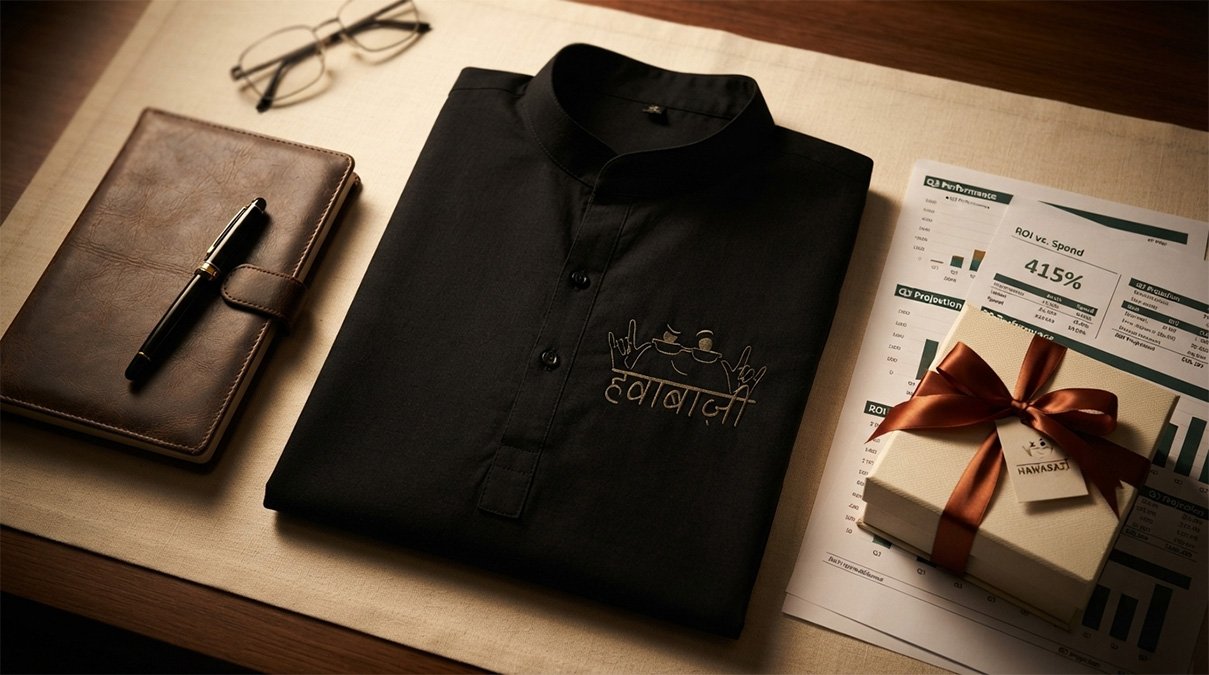
Suresh pushed the budget proposal across the table and looked at his HR head. Tuesday morning, 9:15, and they hadn’t even touched their chai yet. The number on the cover page said Rs 15 lakh. The purpose: an annual corporate gifting ROI India program for clients, employees, and onboarding kits.
Table of Contents
Suresh’s question came before any explanation could start. “Tell me what we get back for the investment.”
Not an unreasonable ask. Any CFO worth their title is going to want more than “it builds goodwill” before signing off on a seven-figure line item. Goodwill doesn’t show up on a balance sheet. Brand warmth doesn’t close the quarter. And with budgets tighter than they were two years ago, every rupee needs a reason.
The truth is that companies in India can actually measure corporate gifting ROI. It’s just that most gifting vendors don’t take the time to explain how. This piece does exactly that.
Why Corporate Gifting Gets Stuck in Finance Review (And How to Unstick It)
Every gifting proposal that lands in a CFO’s inbox carries the same structural problem. The HR team has done the work, selected thoughtful items, priced the catalog, and even sketched out a distribution timeline. But the business case? It reads like a feelings document. Words like “boost morale,” “strengthen relationships,” and “improve culture” do real work inside the HR department. Inside a finance review, they do almost nothing.
This is precisely why corporate gifting ROI India conversations stall. Not because CFOs don’t value people or relationships, but because their job, quite literally, is to ask what the company gets back for every rupee spent. Sentiment is not an answer to that question. Data is.
The gap between “this feels right” and “here is why we should approve this” is where most employee gifting budget justification proposals quietly die. HR brings warmth. Finance brings a spreadsheet. Neither side is wrong; they are just speaking different languages across the same table.
What actually unsticks a stalled gifting proposal is a shift in framing. Stop presenting gifting as a cultural initiative and start framing it as a measurable business investment with trackable outputs. That means defining upfront what success looks like, which metrics the company will track, and what a reasonable return timeline looks like.
When you build the business case that way, it stops being a request for approval and becomes a recommendation backed by evidence. That is a document a CFO can sign.

The Metrics That Actually Matter: What to Measure in a Gifting Programme
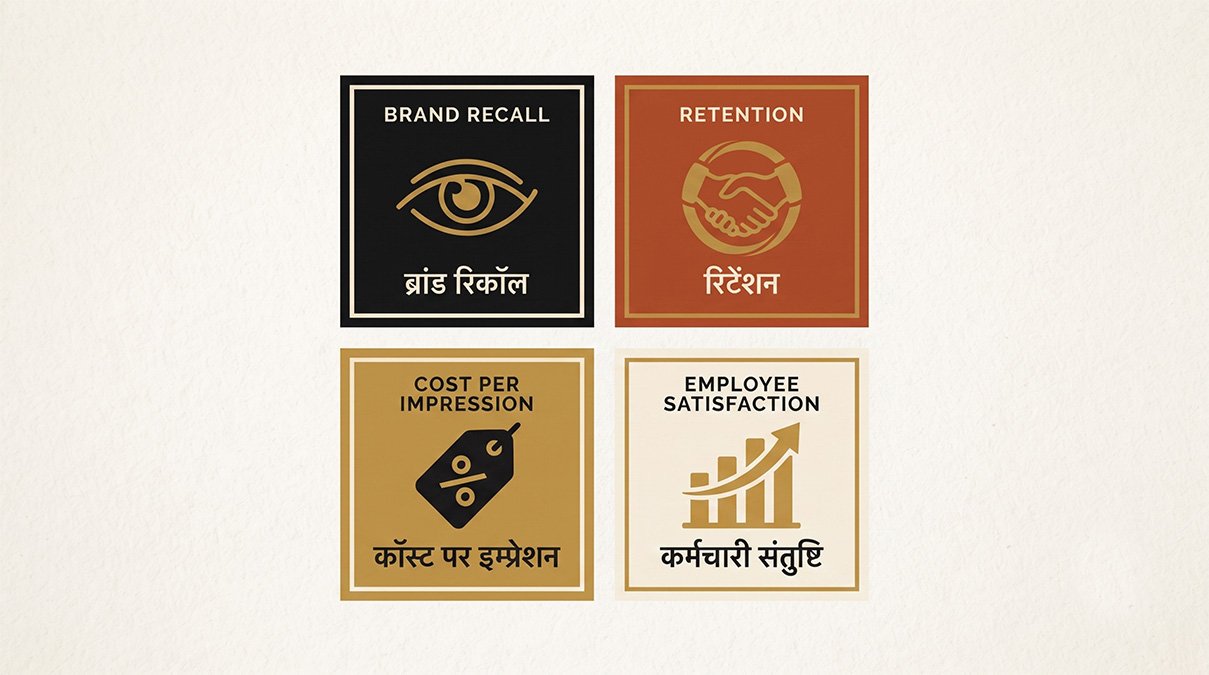
Four numbers. That is what turns a gifting proposal from a feel-good idea into something a finance team can defend in a board review.
Start with brand recall rate. When a client receives a well-designed, custom-printed product from you, how often do they remember your brand when it matters? Research from promotional products associations consistently shows recall rates of 80% or higher for quality merchandise, compared to roughly 20% for a digital banner ad seen once. That gap is not small.
Next, cost per impression. Take your total gifting spend and divide it by the estimated number of times each product gets seen, worn, or used over its lifetime. A Rs 800 custom polo shirt worn twelve times at a client’s office or at an airport? You are looking at cost-per-impression figures that rival, or beat, most paid digital campaigns. That is a number worth putting in the proposal.
Then there is employee satisfaction delta. Run a short pulse survey before the gifting cycle and again six weeks after. Track the movement in scores related to feeling valued and a sense of belonging. Small swings here have documented links to retention.
Finally, the client and vendor retention delta. Compare renewal rates or repeat order frequency in the twelve months following a structured gifting program versus the twelve months before. This is your sharpest corporate gifting program metric in India because it connects spend directly to revenue protection.
Four metrics. All trackable. All defensible in a spreadsheet.

The ROI Calculation Framework: A Step-by-Step Method for Indian Companies
Let’s put Suresh’s Rs 15 lakh on the table and actually work through it.
Step 1: Total Programme Cost
This includes product cost, customization, packaging, logistics, and internal coordination time. For a 500-person program at Rs 15 lakh, your per-unit spend is Rs 3,000. That is your baseline.
Step 2: Attrition Savings
Industry benchmarks from SHRM and Indian HR consultancies consistently place the cost of replacing one mid-level employee between Rs 1.5 lakh and Rs 3 lakh when you account for hiring, onboarding, and lost productivity. If a structured gifting program reduces voluntary attrition by even 2 percentage points across a 500-person workforce, that is 10 retained employees. Conservative savings: Rs 15 lakh to Rs 30 lakh against a Rs 15 lakh spend. The ROI on employee gifting alone can break even before you count anything else.
Step 3: Client Deal Influence Value
Assign a conservative 5% attribution to gifting for each renewed or upsold client account that received a touchpoint gift during the year. If your gifted client base generates Rs 2 crore in renewals annually, that 5% attribution translates to Rs 10 lakh in influenced revenue.
Step 4: Impression Volume from Branded Merchandise
A quality branded jacket or tote changes hands, gets noticed, and gets worn outside the office. Average impression count per quality branded item in Indian urban markets runs between 300 and 500 over its usable life. Multiply across 500 units and you are generating 1.5 to 2.5 lakh brand impressions. At a conservative CPM of Rs 200, that is Rs 30,000 to Rs 50,000 in equivalent media value, not transformative alone but real and additive.
The formula:
> ROI = [(Attrition Savings + Influenced Revenue + Media Equivalent Value) minus Programme Cost] divided by Programme Cost, expressed as a percentage.
Plugging in conservative figures: Rs 15 lakh + Rs 10 lakh + Rs 40,000 minus Rs 15 lakh, divided by Rs 15 lakh. That gives you roughly 69% ROI at the low end. Stronger attrition data or higher client attribution pushes it well past 100%.
Yahi number hai jo board room mein kaam aata hai.
What Custom Printed Merchandise Delivers That a Gift Voucher Cannot
A gift voucher gets spent once. Then it disappears. The person who received it might not even remember which company sent it three weeks later.
A quality custom printed jacket, tote, or desk accessory works differently. It sits on a desk, gets worn to the office, and travels in a bag. Every time someone sees it, your brand registers again. That is not sentiment talking. That is impressions’ math.
Consider the numbers. A Rs 800 gift voucher generates exactly one interaction: redemption. An Rs 800 custom-printed premium tote, worn or carried conservatively twice a week, delivers roughly 100 to 150 brand impressions per month from colleagues, commuters, and clients alone. Over a 12-month lifecycle, you are looking at 1,200 to 1,800 impressions per unit. Cost per impression drops to well under one rupee. No digital ad campaign in India gets close to that without ongoing spend.
This is what makes custom merchandise ROI calculation fundamentally different from evaluating a cash-equivalent gift. You are not comparing one expense to another. You are comparing a single-use transaction to a repeating brand asset.
There is also an emotional variable that finance teams tend to undervalue. Research from multiple consumer behavior studies consistently shows that physical gifts with visible customization create stronger positive associations with the gifting brand than cash or vouchers do. A person who receives something thoughtfully made, with real quality behind it, connects that feeling to your company. That association lingers.
Vouchers are forgotten. Quality lasts, and it quietly keeps working.
Building the Annual Programme Case: Turning One-Off Spend Into a Repeatable Asset
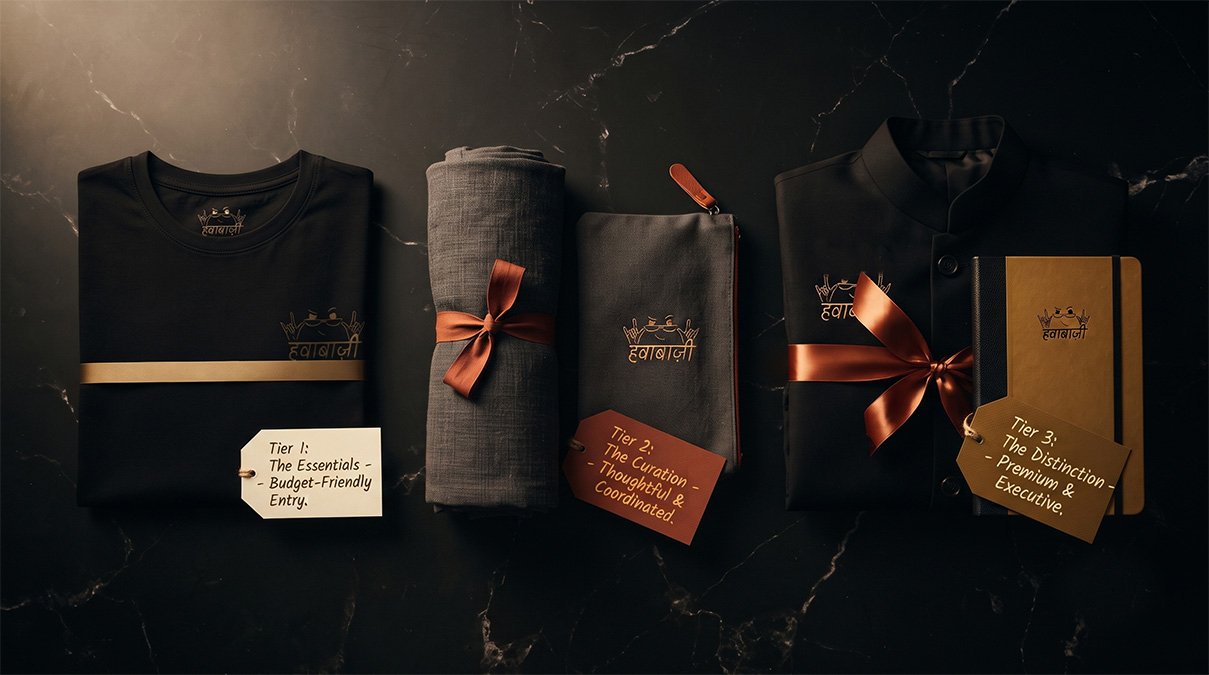
Most companies treat gifting like a one-time event. Diwali arrives, an order gets placed, invoices get cleared, and the conversation ends until someone brings it up again next October. That cycle, repeated year after year without structure, is exactly why gifting spend stays trapped in the “miscellaneous discretionary” column rather than earning a proper line in the annual budget.
Here is what changes when a company formalizes it into a program.
Vendors like Hawabazi build familiarity with your brand identity over time. Your logo placement preferences, your color approvals, your size distribution across employee grades none of that needs to be re-explained every cycle. That operational efficiency alone reduces hidden coordination costs by a meaningful margin, typically 10 to 15 percent on repeat orders.
At scale, per-unit costs drop. A first order of 200 jackets carries higher customization setup costs. The third annual order of 600 units, placed with the same vendor who already holds your brand files, costs noticeably less per piece. The ROI on corporate gifts Indian companies generate from institutionalized programs is structurally better than what one-off orders can ever produce.
For the employee gifting budget justification conversation with leadership, the internal narrative is simple: a recurring program is not a repeated expense. It is a compounding asset. Each cycle builds on brand recognition already established in the last one. Recipients remember the brand that showed up consistently, year after year, not the one that arrived once and went quiet.
That consistency is what turns a vendor relationship into a strategic partnership.

The approval is easier when the numbers do the talking.
Suresh, if you have gotten this section this far, you already know the answer your HR team is hoping you will give. The numbers make a reasonable case. Brand recall, cost per impression, employee retention lift, client relationship value compounding over time—it all adds up to something your spreadsheet can respect.
Corporate gifting ROI India is not a soft metric anymore. It is a line item with a defensible calculation behind it, and now you have the framework to run it yourself before the budget meeting.
Here is what we would say to any finance head sitting on the fence: one well-executed gifting program, done with quality merchandise and real brand intent, tends to answer its own approval question by the second quarter. The data usually does the convincing.
If you want to see how this plays out with Hawabazi’s custom merchandise, our B2B team is happy to build you a projection based on your actual headcount and spend range. No pitch deck, just the numbers.
Hawa ko apni taraf modna ho toh, pehle ek number likho. Baaki hum sambhaal lete hain.



 No products in the cart.