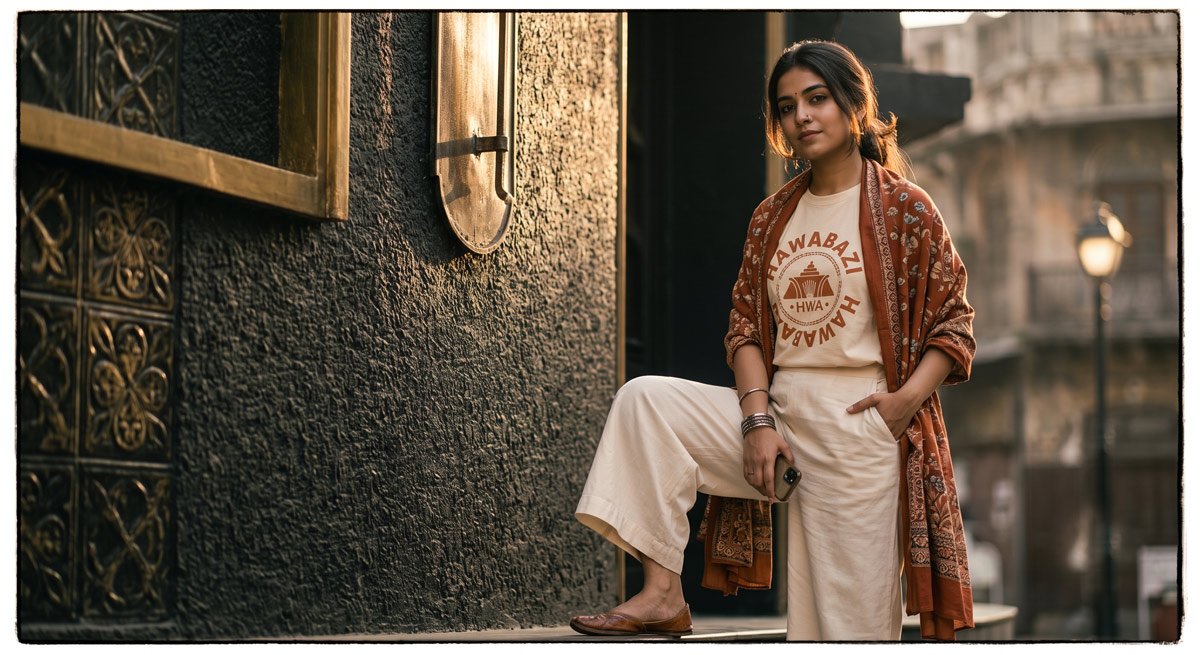
Last Tuesday, Tara posted a mirror selfie at 8 AM before heading to a shoot in Bandra. She wore a striped cotton mix print on the bottom, a Hawabazi graphic tee with a bold block print on top, and a stole she’d knotted loosely around her bag strap. The whole thing was shot in like ten minutes, with zero planning. Comments went a little crazy. “How are you doing this?” “Ek outfit breakdown, please.” Her reply? “I just stopped being scared of it.”
Table of Contents
That’s the whole secret, honestly. Print mixing sounds like it needs some rulebook, some mood board, and some fashion week inspiration. But half the time it’s just confidence and a basic feel for what works together.
If you’ve been curious about how to mix print and pattern in Indian fashion specifically, using the kind of prints we actually grew up with, this guide is for you. We’re breaking it down in a way that actually makes sense.
Why Indian Prints Are Actually Made for Mixing
Here’s something most Western styling guides miss entirely: Indian prints were never designed to exist alone.
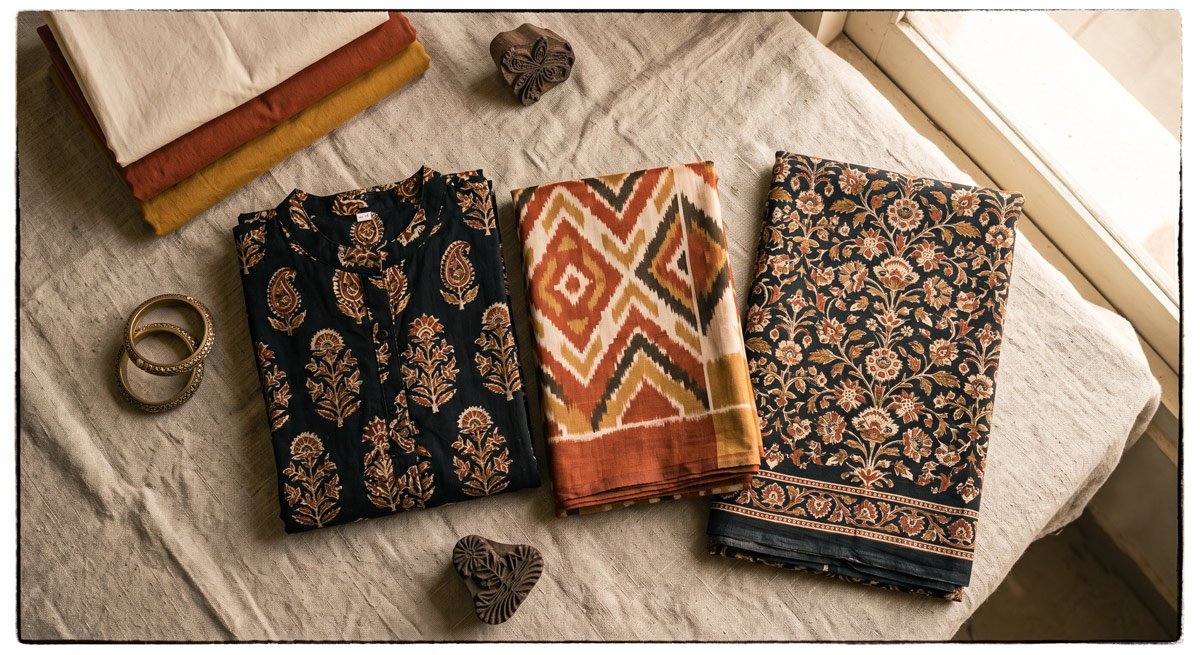
Think about a Rajasthani bazaar. The fabric seller doesn’t lay out one bolt of block print and call it done. He stacks them. Indigo geometrics next to rust florals next to a cream-and-gold ikat. And somehow it all works, because these traditions were built to converse with each other.
Block printing, ikat weaving, and Ajrakh dyeing—these craft forms developed in communities where multiple prints lived together in one room, one market stall, and one wedding mandap. The repeat patterns were intentionally designed with visual breathing room so that when two prints sat next to each other, neither one drowned the other out.
That’s the foundation of how to mix print and pattern in Indian fashion, and it’s honestly a more intuitive system than most people realize:
- Block prints tend to have irregular, slightly imperfect repeats that make them forgiving when layered
- Ikat’s characteristic feathered edges blur the boundary between patterns naturally
- Ajrakh’s geometric logic means it plays well with almost any other structured print
So when you wear a Hawabazi graphic tee with a bold cultural motif and layer a printed stole over it, you’re not breaking a style rule. You’re actually working within a centuries-old visual language that was always meant to be layered, worn together, and mixed up.
Bas, the confidence part is on you.
The One Rule That Makes Indian Print Mixing Outfits Click
leads, and there’s a simple mental shift that makes the whole thing easier. Stop thinking about two prints and start thinking about one print that leads and one that follows.
That’s the anchor-and-accent method. Your anchor print is the dominant one, the piece doing most of the visual work. Your accent print is quieter, smaller in scale, or less saturated. It reacts to the anchor without fighting it.
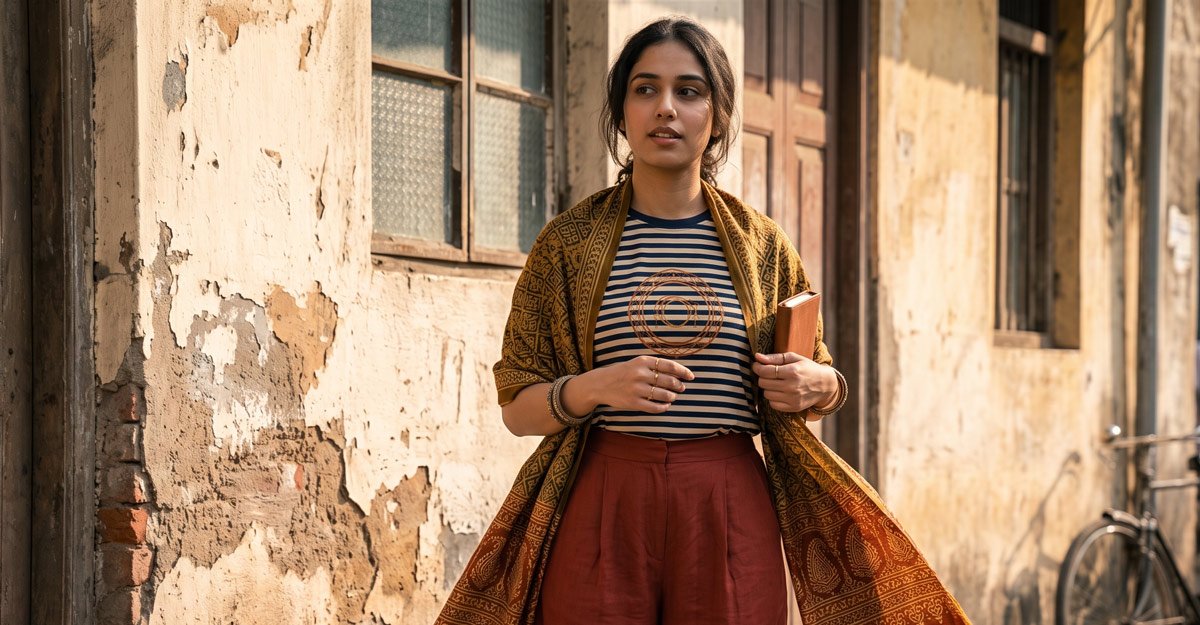
Say you’re building a look around a Hawabazi graphic tee with a bold hand-block motif in rust and cream. That tee is your anchor. Loud and intentional, it carries the whole personality of the outfit. Now you need something that doesn’t compete. A fine geometric stripe in a dupatta, or a subtle ajrakh-inspired stole where the repeat is tiny enough that your eye reads it almost as texture. That’s your accent. The two exist in the same outfit without screaming at each other.
This approach is actually how Indian dressing has always worked, even if nobody named it. A heavily embroidered kurta paired with a plain-weave dupatta with a small border. A big kalamkari print with a thin striped palazzo underneath.
A few things that make this work cleanly in Indian print mixing outfits:
- color: Keep the accent print in a color already living inside the anchor.
- Scale contrast matters: big motif anchors pair best with small-repeat accents.
- If both prints are busy, one must win. Pick your hero.
When you know which print leads, the rest of the outfit almost dresses itself.
Graphic Tees as Your Print-Mixing Base
A graphic tee is doing more work than it looks like in a mixed-print outfit. It’s not the statement piece. It’s the reason the statement piece doesn’t overwhelm you.
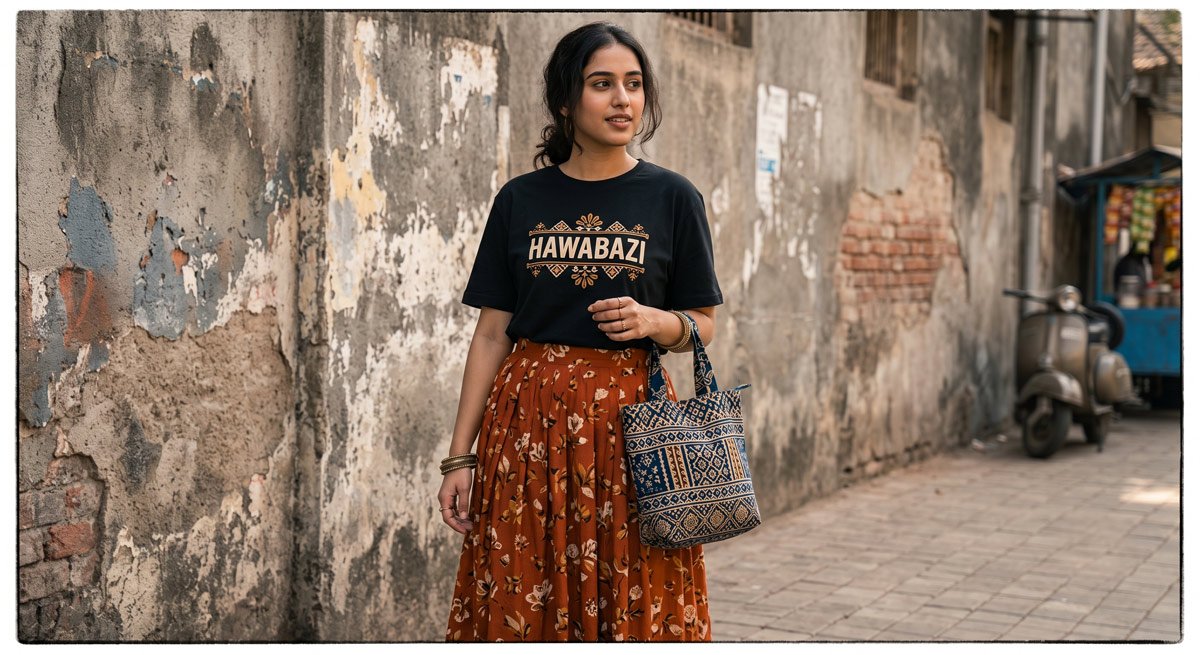
Here’s how it plays out practically. You’ve got a Hawabazi graphic tee, say the ones with bold hand-drawn or block-inspired artwork. The print on the tee already has a strong visual language, but it’s contained within the rectangular frame of the fabric. That containment is exactly what makes it a reliable base. Pair it with a printed stole, a bandhani dupatta draped loose, or even a high-waist skirt with a geometric jaal weave, and the tee functions like a visual anchor that keeps everything readable.
The key thing to watch is scale. If your tee’s graphic is large and centrally placed, go for something with a smaller repeat on the bottom or the stole. A dense floral block-print stole next to an oversized graphic can get crowded fast. But a thinly striped stole? That contrast in scale actually makes both prints pop more.
For graphic tee styling India, the other thing that saves an outfit is the base color. Hawabazi tees in Deep Onyx Black or Warm Cream are genuinely the easiest to build on because they don’t compete. The graphic becomes an accent, the tee becomes ground, and you’ve got room to introduce one more print without it looking like you got dressed in the dark.
How to Style Stoles When Prints Are Already in Play
A stole feels like a finishing touch. It’s not. Drop the wrong one over a print-heavy outfit and the whole look goes noisy in seconds. But get it right, and it pulls everything together in a way that looks effortless, even when you’ve genuinely thought hard about it.
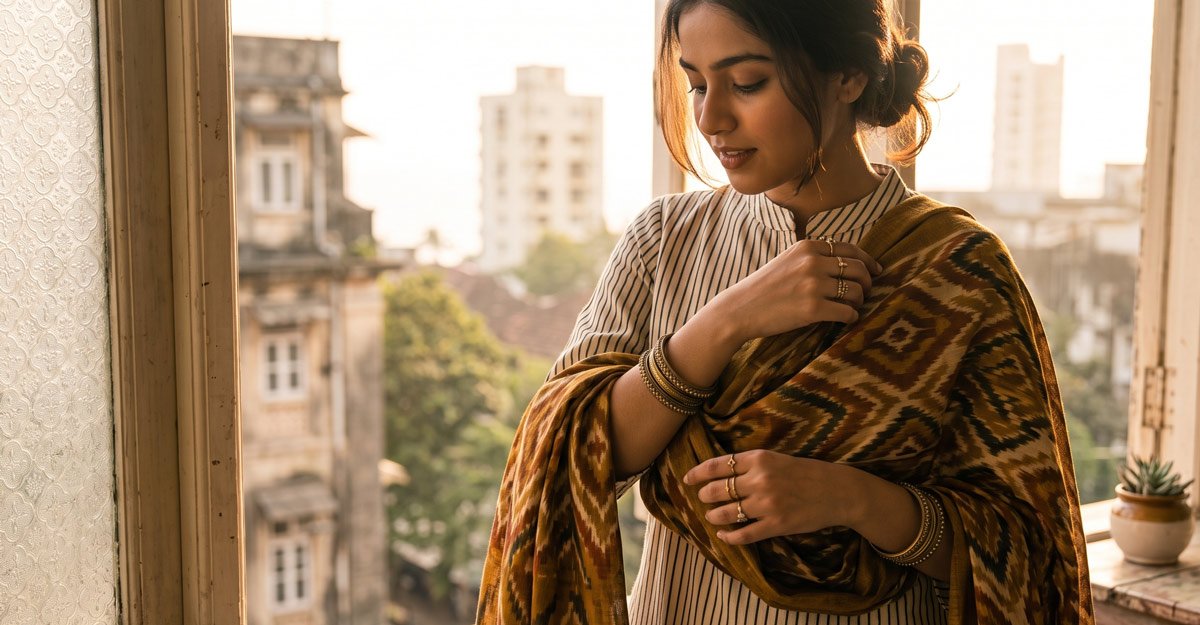
The trick with stoles is always fabric weight first. If your anchor piece is a structured Hawabazi graphic tee in a heavy cotton, your stole needs to be lighter: a fine cotton, a soft georgette, or a crinkle weave that drapes rather than sits. Two heavy fabrics competing for attention on the same body creates bulk, not layering.
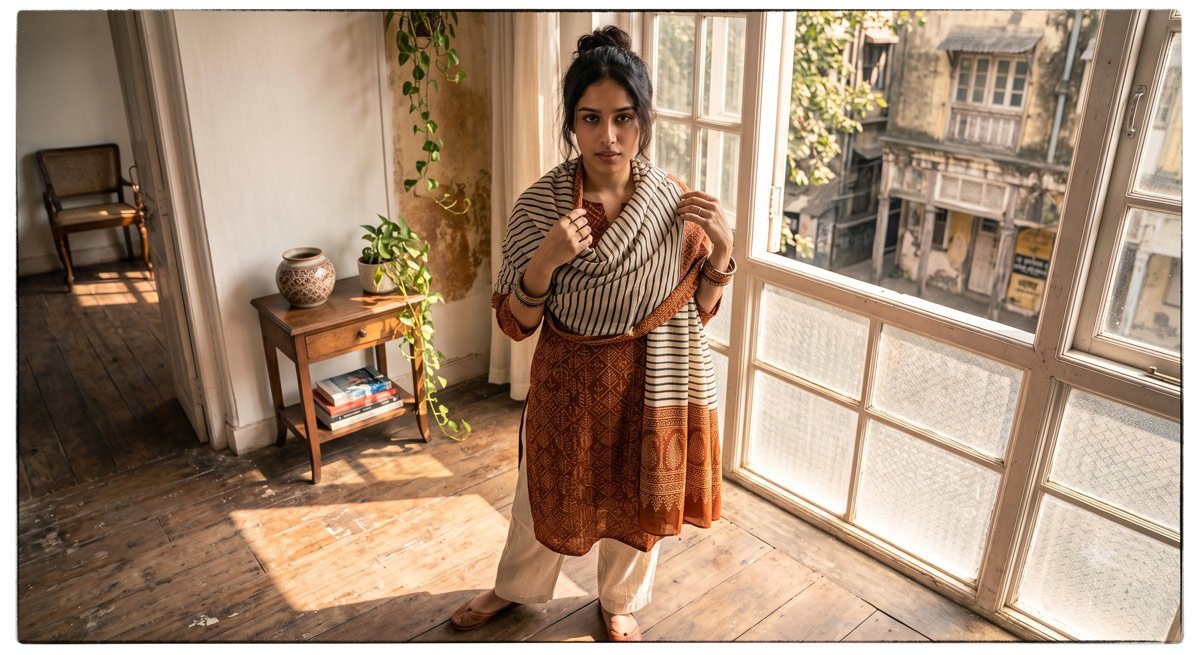
Drape direction matters more than most people realize. A straight front-tuck drape emphasises the print you’re wearing underneath it, so use this technique when your stole’s print is subtle. Sling it off one shoulder asymmetrically, and suddenly the stole becomes the accent print, the one your eye lands on second. That shift is everything for mixing prints and patterns in Indian fashion.
Color-matching rule, simple version: pick one color from your anchor piece and find it again in the stole. Not a perfect match. Close is better. A rust in your graphic tee’s block print echoed in a terracotta-toned floral stole? That works.
A few combos that actually land well:
- Bold geometric tee + fine stripe stole in a tone from the tee’s palette
- Floral kurta fabric + a solid-adjacent ikat stole (ikat reads as almost solid from a distance)
- Hawabazi block print graphic tee + a lightweight ajrakh-style stole, same base color family
Don’t knot the stole if your outfit is already layered. Let it drape loose. The outfit’s doing enough.
Streetwear Meets Indian Print: Breaking the Either/Or
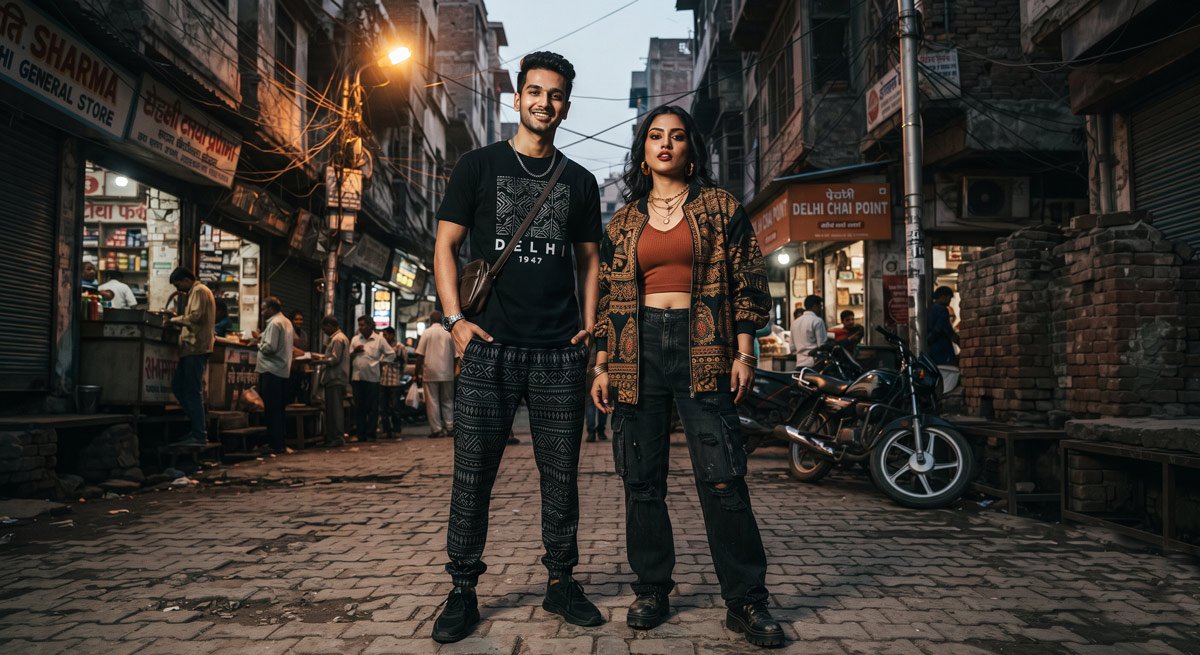
Streetwear and Indian print have been treated like two different wardrobes for too long. You wear your block-print kurta to the family lunch and your graphic tee to the café in Hauz Khas. The two never meet. That separation is the problem, and honestly, it’s a very recent invention.
Look at how Delhi street style has actually evolved over the last three or four years. The kids outside DU who are genuinely well-dressed aren’t choosing between desi and street style. They’re layering a bold kalamkari-print overshirt over a washed-out crew neck. Tying a geometric ikat around the waist like a belt. Wearing an embroidered mirror-work jacket over joggers. That’s not experimental anymore. It’s just a way of dressing.
Hawabazi’s graphic tees work particularly well here because the prints aren’t trying to be Western. There’s a cultural reference in the graphic, a deliberate design choice, which means they share visual DNA with Indian block prints and florals in a way a plain band tee never would.
For streetwear with Indian prints to actually land, a few things help:
- Keep the silhouette relaxed. Oversized or straight-cut pieces absorb print better than fitted ones.
- One piece with a loud Indian motif, one piece with a graphic or geometric, and you’ve already got a complete tension.
- Let the footwear be the full stop. Kolhapuris with cargos. Jutti with joggers. It grounds the mix instantly.
This is how to mix print and pattern in Indian fashion, not as an experiment you attempt once, but as a default language.
Your Wardrobe, Your Rules: Start Mixing Today
Styling rules exist for a reason, sure. But the best outfits Tara has ever worn, or you have, probably broke at least one of them. That’s the whole point of learning how to mix print and pattern in Indian fashion: once you understand why certain combinations work, you stop asking for permission.
Start small if you like. A Hawabazi geometric tee with a printed stole you already own. See how it feels. Ab wahan se aage badho. Add a floral dupatta to that striped kurta sitting in the back of your wardrobe. Wear it to your cousin’s Sunday brunch and watch people ask where you got the idea.
Print mixing is not a talent you’re born with. It’s just practice and a little bit of pakka confidence. The more you experiment, the faster your eye starts to calibrate what works.
Your wardrobe has more in it than you think. So does ours. Explore the Hawabazi collection, pull something unexpected, and put it together your way. #ApniHawaBanao #Hawabazi #PrintMixing #IndianFashion #DesiStyle #GraphicTees #BlockPrint #StyleGuide #IndianStreetWear #WardrobeInspo #EthnicFusion #MumbaiFashion #DesiOOTD

 No products in the cart.