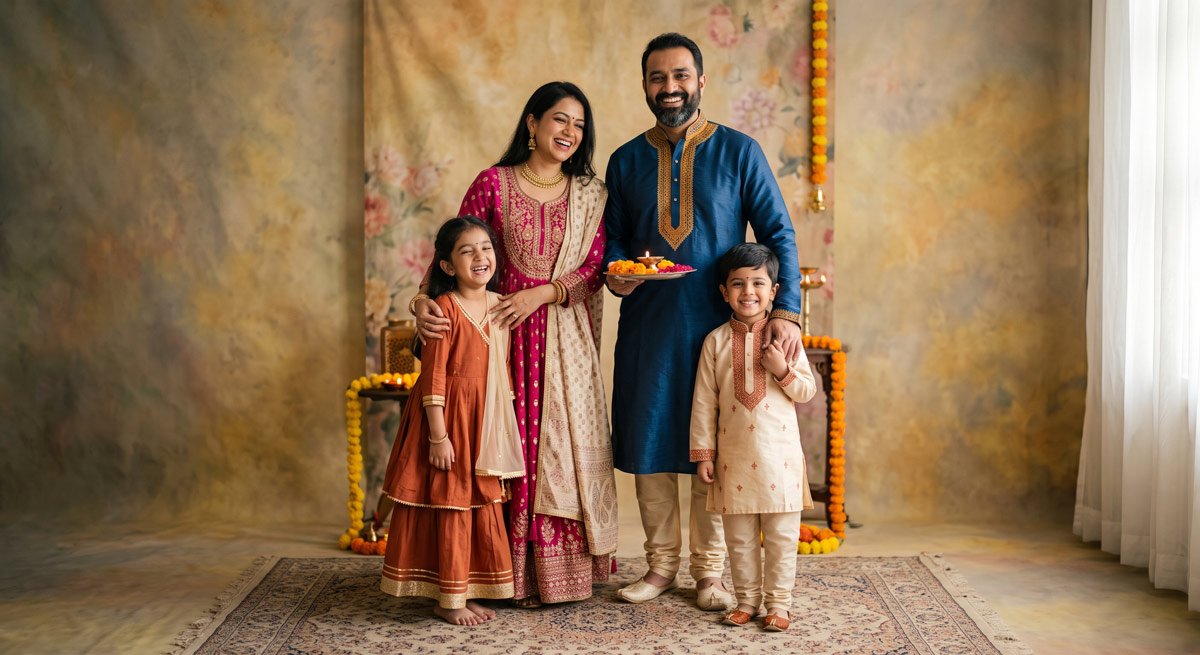
January mein ghar mein ek khaas kaam hota hai. This year, my neighbor Sudha sat down with a cup of chai, her kids’ school holiday list, and a notebook she’s been using since her eldest was in Class 2. By the time she finished her second cup, she had a rough plan for every major coordinated family outfits moment, from Pongal straight through to Christmas. Diwali ki saari, her son’s kurta for Eid, a matching set for the cousins who’d fly in from Hyderabad for Navratri. All of it was mapped before February even started.
Table of Contents
She’d learned the hard way. Two years ago, a panicked call to three different tailors in October ended with mismatched dupattas and her daughter wearing the wrong shade of red.
If you’re the kind of person who thinks ahead, this guide is for you. Here’s how to plan coordinated family outfits for Indian festivals across the full year, without the last-minute chaos.
India’s Festival Calendar, Month by Month
January kicks off with Lohri on the 13th, and if you’re in Punjab or have Punjabi friends, you know the bonfire goes up fast. Mustard yellows, burnt oranges, and deep reds. Coordinated family outfits for Indian festivals start right here, not in October. A week later, Makar Sankranti (or Pongal in Tamil Nadu and Uttarayan in Gujarat) calls for fresh cotton kurtas in harvest shades, mostly whites and greens.
February is quieter on the festival front, which is actually a welcome break. Use it to plan.
March brings Holi, and yes, white is the classic canvas, but plenty of families are now doing pastels so the dupatta at least survives. Ugadi and Gudi Padwa fall here too, mid-month usually, and they need their own traditional silhouettes.
Thereaftert, the schedule fills up and the pace quickens:
- April-May: Baisakhi, Ram Navami, Eid al-Fitr (date shifts annually, check ahead)
- July-August: Teej, Raksha Bandhan, Janmashtami, Independence Day, then Onam if you’re in Kerala
- Dooj, October-November: Navratri’s nine nights, Dussehra, then Diwali, Bhai Dooj, and Chhath Puja back to back
- December: Christmas, and in many families, a New Year’s look too
The October-November stretch is where most families suddenly panic. If you sort your festive family matching outfits by September, you’re already ahead of half of India.
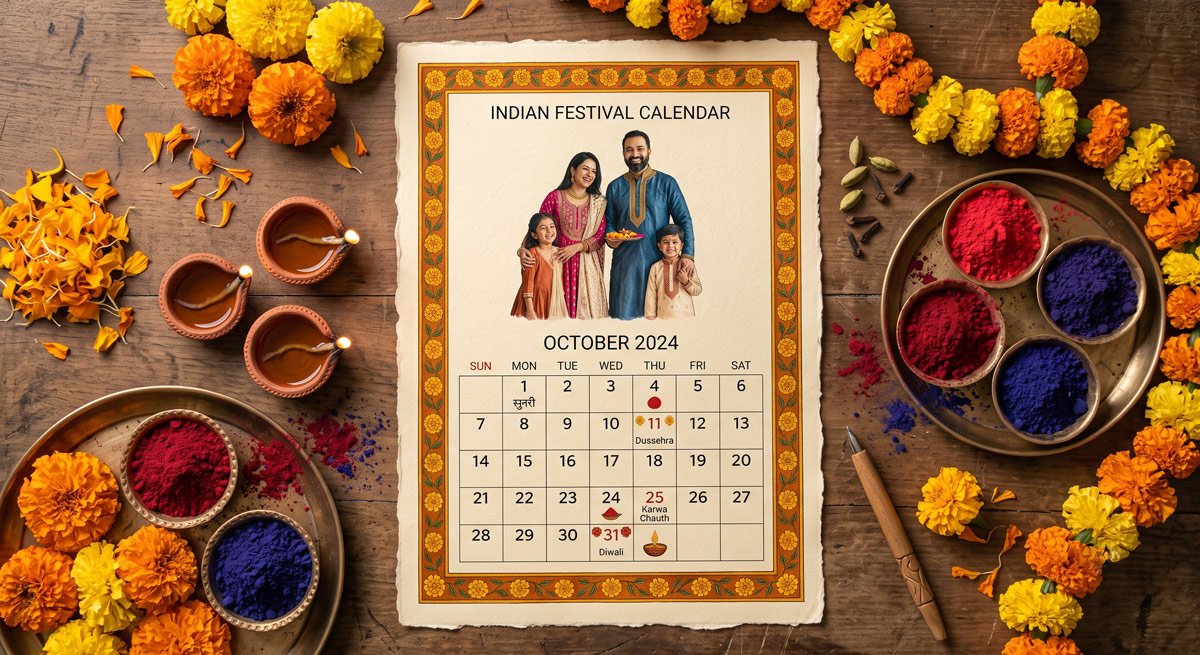
Alt: Indian festival calendar flat-lay with marigolds, diyas, and colored powders representing year-round celebrations
Outfit Themes That Actually Work for Each Family Festival Outfit
Every festival has its own mood. Get the palette wrong, and even the most expensive outfit feels off.
Holi (March): Start in all-whites or very pale creams. Yes, they’ll get splashed with color, but that’s the idea. Kids wear white kurtas, while parents wear simple cotton coord sets. Let the colors do the rest.
Eid and Baisakhi (April): These two fall close together but ask for very different energy. Eid calls for pastels and softer golds, think pale mint, blush, or ivory with subtle embroidery. Baisakhi is louder. Women can wear Phulkari-inspired patterns in bright yellows and electric blues, while men can opt for classic off-white kurtas.
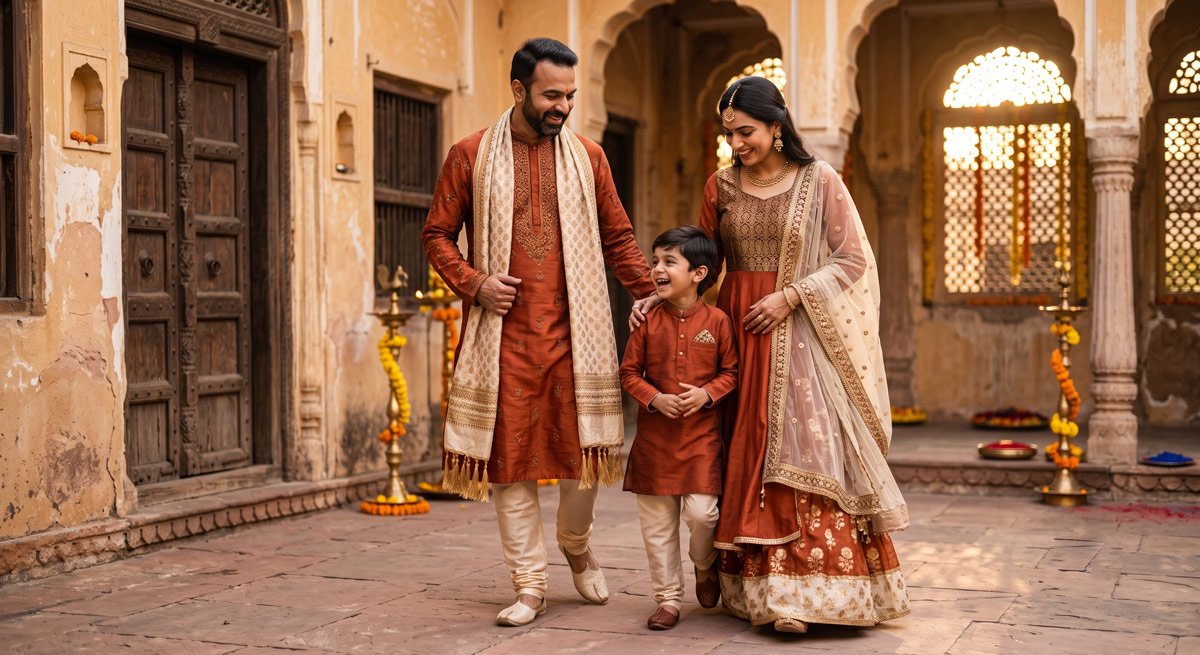
Dussehra (October): Saffron, ochre, and deep maroon. Traditional silhouettes work best here. Women wear Anarkalis, men wear straight-cut kurtas with slim churidar, and little boys wear matching Nehru-collar sets.
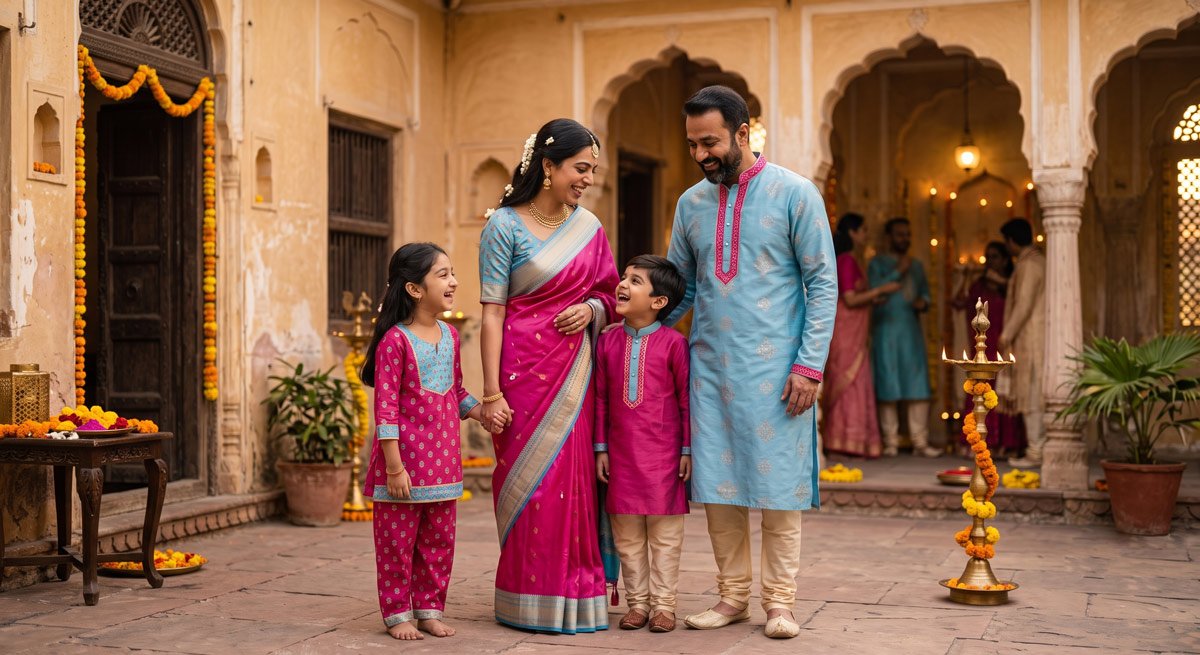
Diwali (October-November): This is when families go all in. Jewel tones: deep teal, ruby red, royal purple, and loads of gold detailing. Lehengas, silk kurtas, and kids’ sherwanis. When the diyas glow and everyone dresses up, these rich colors photograph beautifully.
Christmas and New Year: Burgundy, forest green, and off-white. A little Western, a little desi – honestly, that’s how most Indian families celebrate these days anyway.
The silhouette matters as much as the color. Coordinated family outfits doesn’t mean matching exactly. It means your family looks like they belong together in the same frame. Regenerate this section.
Your Ordering Timeline: When to Shop, Not Just What
Most families shop when they remember, not when they should. That’s how you end up paying extra for express shipping, or worse, settling for whatever’s still in stock three days before Diwali.
Here’s a rough timeline that actually works:
- Custom or stitched pieces (sherwanis, lehengas, coordinated kurta sets with embroidery): order at least 6 to 8 weeks before the festival date. That means if Diwali falls in late October, your order should be placed by early September.
- Ready-to-wear coordinated sets: 3 to 4 weeks is comfortable. If you’re lucky and the sizes are available, you might get it in two weeks.
- For kids’ outfits specifically, add at least an extra week. Kids grow, and alterations take time.
For coordinated family outfits for Indian festivals, the math gets trickier because you’re not ordering one piece; you’re matching across three or four different body types and sizing categories simultaneously. That coordination takes longer to process, even at brands that are used to bulk and family orders.
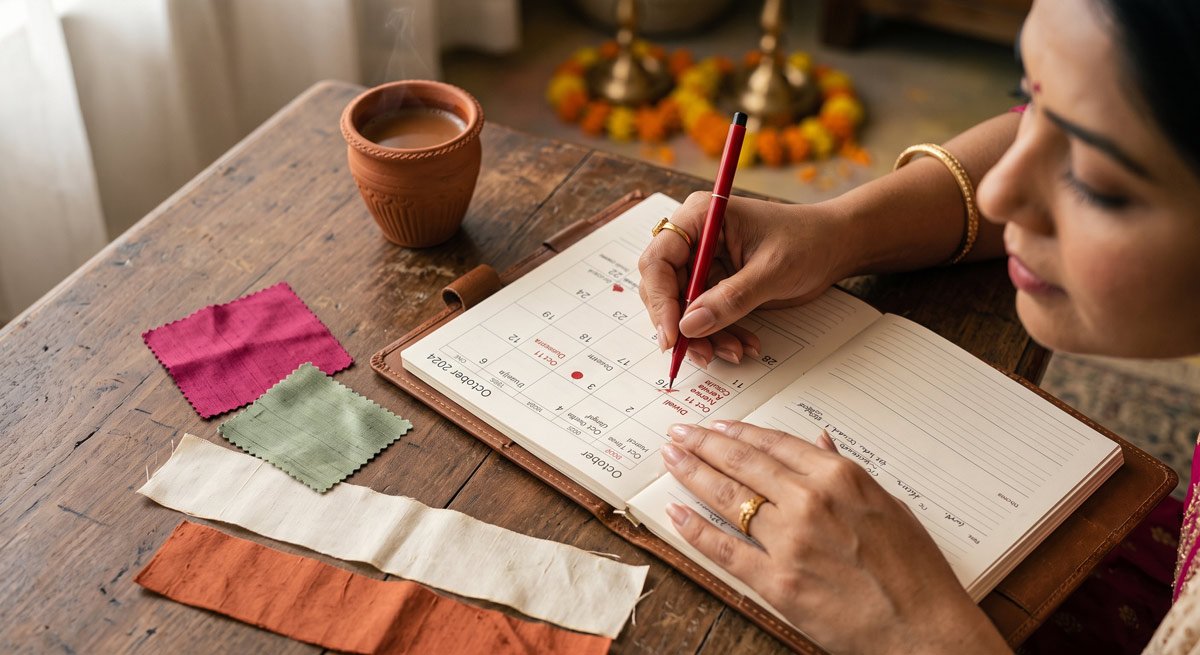
The safest way to use the guide for Indian festival outfit logic is to mark every major festival date in your calendar right now, then count backwards. Set a reminder six weeks out. If that reminder fires and you haven’t started yet, please start immediately. Don’t wait for the “right time.”
October and November are the absolute worst months to delay. Navratri flows straight into Dussehra, then Diwali follows, and every family in India is ordering at the same time. Regenerate this section.
Building a Festive Capsule Wardrobe That Earns Its Place
Think of your festive wardrobe the way you’d think of a well-stocked kitchen. You don’t buy a new jar of haldi for every dish. You build from a few solid foundations, and everything else comes together around them.
The same logic works beautifully for coordinated family outfits for Indian festivals. Instead of hunting for an entirely new set every single time, you invest in a handful of pieces that pull weight across multiple occasions through the year.
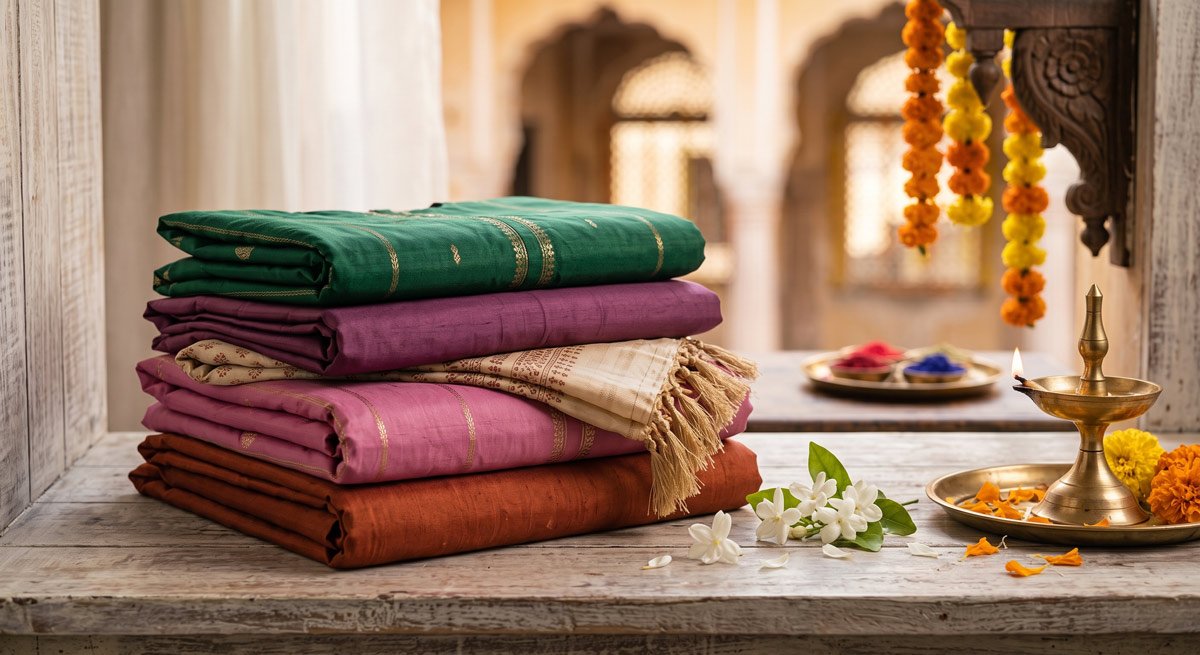
For the adults, a well-cut kurta in a deep cream or slate grey travels surprisingly far. Pair it with a bright dupatta and heavier jewelry for Karva Chauth. Swap in rust-toned separates, and it’s Navratri. Tone everything down with minimal accessories, and it becomes a clean Eid afternoon look. One base garment, three different evenings.
Kids are easier than people think. A good anarkali in a muted gold or a classic kurta pyjama in dark onyx can rotate with different color accessories depending on the festival palette. You’re not buying new; you’re restyling what you already have.
For festive family matching outfits that actually work across the calendar, focus on:
- Neutrals and muted tones as your anchor pieces (cream, slate, ivory)
- One or two bold accent colors per family member that photograph well together
- Fabric choices like cotton-silk blends that feel equally right in February and October
The pieces that earn their place in your wardrobe are the ones you reach for again without hesitation. Regenerate this section.
How Hawabazi Covers Every Festival, Every Size, All Year
One thing that comes up again and again when families write to us: “Do you have something for my mother-in-law too? She’s a size 2XL.” Or “My son is only three; can he match?” The answer, almost always, is yes.
Hawabazi’s range is built for the whole family, not just the couple in the photo. Hawabazi’s range includes men’s kurtas and sherwanis, women’s salwar sets and ethnic fusion pieces, and kids’ kurtas starting from sizes as small as 18 months. The coordination isn’t forced either. If the women are in a rust and cream palette for Navratri, there’s a corresponding piece for the kids and a matching bandhgala option for the men that ties everything together without making it look like everyone rolled out of the same fabric roll.
The festive collection of matching outfits for families at Hawabazi covers the full Indian calendar. Lohri to Christmas. Pongal to Eid. Onam to Bhai Dooj. Each festival gets its own palette direction and silhouette mix.
The process for bulk orders and corporate gifting is straightforward, as more families are choosing to gift matching sets to cousins or send coordinated outfits to relatives in other cities than you might expect. Place your bulk order at least three to four weeks before the festival. Custom sizing requests need a little more lead time, closer to five weeks.
Every size. Every occasion. That’s what coordinated family outfits for Indian festivals should actually look like in practice.
Your Family’s Festival Year, Sorted Before It Starts
Somewhere between Lohri and Christmas, the year just disappears. One festival bleeds into the next, and if you haven’t planned, you’re suddenly at a Diwali party in last year’s kurta hoping nobody notices. Meena, you know exactly what we’re talking about.
The whole point of keeping a guide like this bookmarked is that you don’t have to start from scratch every time. Pull it out in October when Diwali orders need to go in. Check it again in February before Holi arrives. Let it do the thinking, and you can actually enjoy the occasions.
Coordinated family outfits for Indian festivals don’t have to be a big annual project you dread. With a little planning upfront, ek baar mein the whole year comes together, and the kids stop wearing mismatched dupattas to family photos.
Browse the Hawabazi collection when the next festival is still a few weeks away, not two days before. That’s when you’ll find the right pieces, the right sizes, and enough time for everything to actually feel special.
Ab bas, shuru karo. The calendar is already running.
ApniHawaBanao #Hawabazi #FamilyOutfits #FestiveWear #IndianFestivals #FamilyMatching #DiwaliOutfits #NavratriLooks #DesiFamily #EthnicWear #FestivePlanning #IndianKurta #OccasionWear #DesiStyle


 No products in the cart.